
Before It Becomes an Emergency: The Real Value of 24/7 Proactive Care
- May 19
- 4 min read
# Before It Becomes an Emergency: The Real Value of 24/7 Proactive Care
*From the Apex Health clinical team*
---
The American healthcare system is configured around a single assumption: people will seek care when they realize they are in trouble. By the time that realization arrives, the cheapest moment to act has usually already passed.
Most employer health plans inherit that configuration. They function as emergency intercept systems with a wellness program bolted onto the front. Premiums spike, ER claims drive renewal pressure, the broker shops the market again, and the cycle resets. Apex Health was built to invert it.
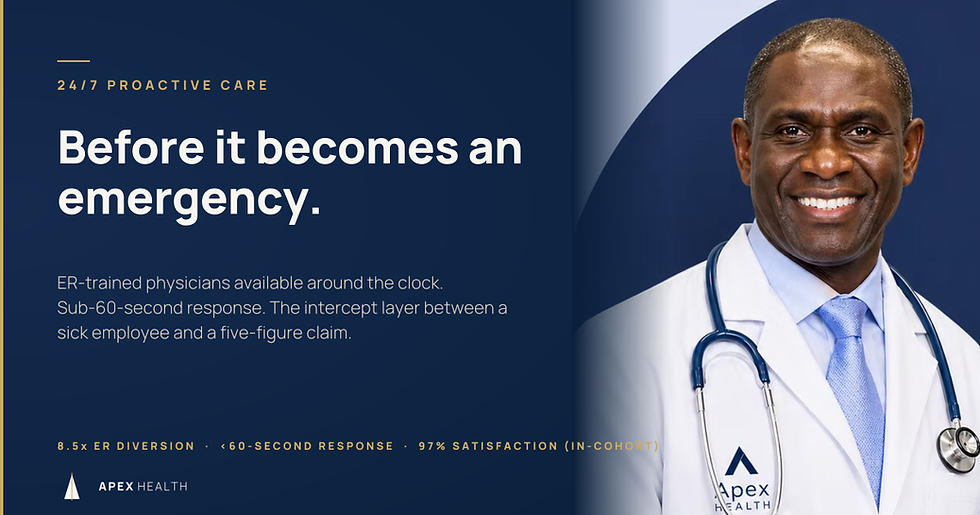
The mechanism is simple. Physicians who are trained for the ER are available to your employees at any hour, in under sixty seconds, before the moment of crisis. Not after. Not in the ER waiting room. Before.
## What "24/7 ER-trained" actually means
Two words in that phrase do most of the work, and both are easy to misunderstand.
**"24/7"** in our case means a real physician answering a real call. Not a chatbot. Not a triage nurse routing to a callback queue. Not a telehealth app where the doctor logs on during business hours and disappears at six. Sub-60-second response, around the clock, with full clinical authority to treat, prescribe, refer, or escalate.
**"ER-trained"** is the discriminator most virtual care platforms cannot claim. Routing a chest pain call to a primary care physician is not the same as routing it to a physician who has spent years in an emergency department deciding which chest pains are cardiac and which are heartburn. The cost difference between those two judgment calls — measured at the claim line, over a year, across a population — is significant.
## The economics of intercepting before escalation
Consider the cost curve of a single clinical event from start to finish:
A primary care visit. A virtual urgent care consult. An after-hours emergency department visit. An ER visit with admission. An ICU admission with complications. Each step on that curve is a multiple of the one before it.
The point of 24/7 proactive care is to keep events on the left side of that curve. Most clinical situations that end in the ER did not have to. A non-trivial fraction of them began as a question that, if asked early and answered correctly, would have resolved at the primary care end of the spectrum.
In typical Apex Health client cohorts, the ER diversion rate is approximately 8.5x baseline. That is not a rounded marketing figure. It is what happens when the response time is sixty seconds and the physician on the line knows what an emergency looks like and what does not.
## Why traditional EAPs and telehealth do not replicate this
The market is crowded with employee assistance programs, telehealth apps, and benefits portals. They are not the same product. Three structural differences:
**Response time.** Most telehealth apps advertise response times measured in minutes to hours. By the time an anxious employee waits ten minutes for a callback, half of them are already in the car driving to urgent care. Sub-60-second response changes the behavioral economics of the moment.
**Clinical credentialing.** Most telehealth platforms staff with the lowest-cost licensed clinician who can complete the visit. That works for a sinus infection. It is not the right configuration for the situations that actually drive claims volatility — chest pain, abdominal pain of unclear etiology, mental health crises, pediatric emergencies, post-surgical complications.
**Continuity.** A one-off virtual visit produces an isolated transaction. Twenty-four-hour proactive care is part of an integrated stack that includes RPM, care management, risk stratification, and longitudinal data. The physician who answers your call knows the patient's history. That changes everything about the clinical decision they make.
## The CFO frame
For the finance buyer evaluating this layer, the calculation is straightforward. The average cost of an ER visit in the United States ranges from approximately $1,200 to over $3,000 before any admission. The average cost of a virtual care visit through an integrated stack runs a small fraction of that. Multiply by your employee population, multiply by typical ER utilization rates, multiply by the diversion percentage, and the savings line emerges clearly.
The PMPM fee for the Apex Health layer is deductible under IRS Section 162 as an ordinary and necessary business expense. Discuss specific structuring with your finance and tax counsel.
## What this means for your workforce
For the employee, twenty-four-hour proactive care changes the calculus of when to seek help. Most people do not call a doctor at 11 p.m. because they are not sure it is "worth it." Most people drive to the ER at 11 p.m. because they are sure they have run out of options. Sixty-second access to an ER-trained physician closes that gap.
The clinical outcome is fewer late escalations. The financial outcome is fewer high-cost claims. The cultural outcome is an employee population that feels actually supported, not enrolled in a benefit they cannot navigate.
That is the difference between care and an emergency.
---
**Curious what twenty-four-hour proactive care could mean for your claims line?**
[Take our Healthcare Claim Assessment →]https://www.aichealth.net/healthriskassessment)
**See the full Apex Health stack and how it integrates with your existing benefits.**
[Visit apexhealth.ai →]https://www.aichealth.net/
---
**Apex Health**
*The physician-led platform for employer healthcare cost reduction.*
> **Skip the ER for non-emergencies — call 911 for true emergencies.**



Comments