
Catch What Claims Data Misses: The Quiet Power of Physician-Supervised Remote Patient Monitoring
- May 19
- 3 min read
#Catch What Claims Data Misses: The Quiet Power of Physician-Supervised Remote Patient Monitoring
*From the Apex Health clinical team*
---
Most employer cost-containment strategies wait for claims to roll in. By the time a claim shows up in the report, the spend is already booked, the patient already managed, and the cost already locked. Remote Patient Monitoring — RPM — works the other direction. It is the difference between watching a fire on the news and pulling the alarm before the smoke gets to the second floor.
Done well, RPM is one of the highest-leverage cost-containment tools available to a self-funded or level-funded employer. Done poorly — or not at all — it is a missed quarter.
## What RPM actually is
RPM is continuous, physician-supervised monitoring of employees with elevated risk profiles or chronic conditions. The mechanics: connected devices (blood pressure cuffs, glucose monitors, pulse oximeters, weight scales, and others as clinically indicated) feed real-time data to a care team. Clinicians review the data. When something moves in the wrong direction — a blood pressure trending toward hypertensive crisis, a glucose pattern suggesting impending diabetic complications, a weight gain pattern signaling heart failure decompensation — the team intervenes before the patient even knows there is a problem.
That is the entire mechanism. It is not magic. It is paying attention, at scale, with the right clinical judgment behind the alerts.
## Where the savings actually come from
The savings are not in the monitoring. The savings are in the interventions that monitoring makes possible. Four specific places:
**Avoided readmissions.** In typical client cohorts, RPM-supported transitions of care reduce 30-day readmission rates by approximately 45%. A readmission claim runs five-figures. A monitoring intervention runs a small fraction of that.
**Prevented acute episodes.** The biggest claims in any employer population are catastrophic events — heart attacks, strokes, diabetic emergencies, sepsis cascades. Most of them are preceded by a window of measurable physiological warning signs. RPM catches that window. In-cohort data shows up to 85% prevention of these catastrophic events when monitoring is paired with active physician oversight.
**Lower medication waste and tighter therapy adherence.** Continuous data allows physicians to titrate medications in real time instead of guessing between quarterly office visits. The result: fewer drugs prescribed, better outcomes per drug, and lower pharmacy spend.
**Reduced ER and urgent care visits.** A patient who knows a physician is watching their numbers and will reach out at the first sign of trouble does not panic and drive to the ER over a borderline reading.
## The ROI honesty check
A common claim in the RPM market is the 7x-to-15x ROI figure. The honest version: ROI depends almost entirely on which employees are enrolled. RPM applied to a young, healthy workforce returns very little. RPM applied to the rising-risk 10-15% of any employer population — the cohort that drives roughly 50-70% of total claims — returns significant savings.
The discipline is in the targeting, not the technology. Apex Health's risk stratification engine identifies the employees who will move the claims line, and routes them into monitoring before they generate a high-cost event. The 13.6x steady-state ROI figure we model assumes that discipline is maintained.
## Why physician-led matters
A monitoring program without physicians is a data pipeline. A monitoring program with the right physicians is a care system.
Continuous data without clinical interpretation generates two failure modes: alert fatigue (where the team stops responding) and missed signals (where real deterioration gets buried in noise). The discriminator between an RPM program that produces savings and one that produces a dashboard is whether the people reviewing the data have the clinical judgment to know what to do about it.
Every Apex Health RPM cohort is overseen by physicians on our clinical team. That is not a marketing line — it is what makes the economics work.
## Where RPM fits in the Apex stack
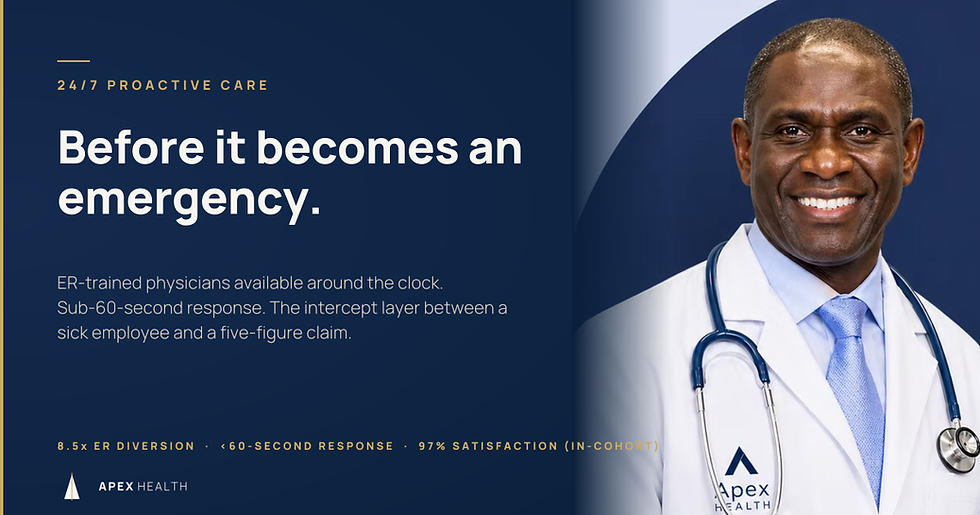
RPM is one layer of the Predict-Care-Integrate framework that drives every Apex Health deployment. Risk stratification identifies the right employees. RPM provides the early-warning system. Integrated care management connects monitoring data to actionable interventions. Twenty-four-hour ER-trained virtual care provides the on-demand layer when something does escalate.
The result for employees is fewer unexpected emergencies and tighter clinical relationships. The result for employers is a measurable reduction in the most expensive parts of the claims line — readmissions, catastrophic events, and avoidable ER utilization — without disrupting the existing carrier or broker arrangement.
---
**Want to see what RPM could mean for your workforce?**
[Take our Healthcare Claim Assessment →(https://www.aichealth.net/healthriskassessment)
**Learn more about how the Apex Health stack works alongside your existing benefits structure.**
---

**Apex Health**
*The physician-led platform for employer healthcare cost reduction.*


Comments