
Healthcare Costs Are Rising Again in 2026. Waiting Until Renewal Is the Most Expensive Mistake an Employer Can Make.
- Apr 22
- 3 min read
Healthcare costs are rising again, and the latest employer data is not subtle. Mercer found that employer health benefit cost per employee rose 6.0% in 2025 and is projected to rise another 6.7% in 2026, the highest increase in 15 years. Business Group on Health reported employers expect a median 9% health care cost increase for 2026, reduced only to 7.6% even after plan design changes. PwC projects 2026 medical cost trend at 8.5% for the group market.
That is not a routine benefits adjustment. It is a margin event. It is a workforce affordability event. It is a leadership event.
Most employers still make the same mistake: they treat healthcare inflation like a renewal problem. It is not. By the time renewal arrives, the claims are already on the books, the utilization pattern is already established, and the leverage is already gone. A broker can negotiate around the edges. A carrier can reprice the risk. But neither changes the fact that unmanaged claims behavior upstream becomes locked-in cost downstream.
That is the real issue. Employers do not only have a premium problem. They have a claims-performance problem.
The pressure is being driven by exactly the areas most employers struggle to control in real time: pharmacy trend, chronic-condition drift, mental health utilization, and avoidable high-cost care events. Mercer reported prescription drug spending rose 9.4% on average among large employers in 2025, with growing GLP-1 utilization as a key contributor. Mercer also reported that 49% of large employers covered GLP-1 weight-loss medications in 2025, up from 44% in 2024. PwC likewise reported that pharmacy cost trend is running 2.5 points above medical trend. Business Group on Health identified GLP-1s, cancer, and mental health services as major drivers of 2026 cost growth.
The employee side is tightening too. KFF reported that average family coverage in employer-sponsored plans reached $26,993 in 2025, with workers paying $6,850 toward that premium. Mercer separately stated that health benefit costs are rising faster than inflation and wage growth. That means more financial pressure on employees, more delayed care, more treatment avoidance, and eventually more expensive claims when small issues become large ones.
This is where weak strategy becomes expensive strategy.
When employers do nothing until renewal, they effectively subsidize drift. They allow employees to default into fragmented care, inappropriate sites of service, unmanaged medication patterns, reactive chronic care, and unnecessary emergency utilization. Then they try to solve a twelve-month claims problem in a thirty-day renewal window. That is not cost management. That is late-stage damage control.
The smarter move is to intervene before renewal, when behavior can still be redirected and avoidable claims can still be prevented.
That means changing how care is accessed, guided, and managed across the plan year. It means giving employees a front door that can direct them away from the wrong setting before an avoidable ER visit occurs. It means earlier intervention for high-risk members. It means tighter prescription oversight. It means physician-led navigation rather than passive reimbursement after the fact.
This is the lane Apex Health was built to solve.
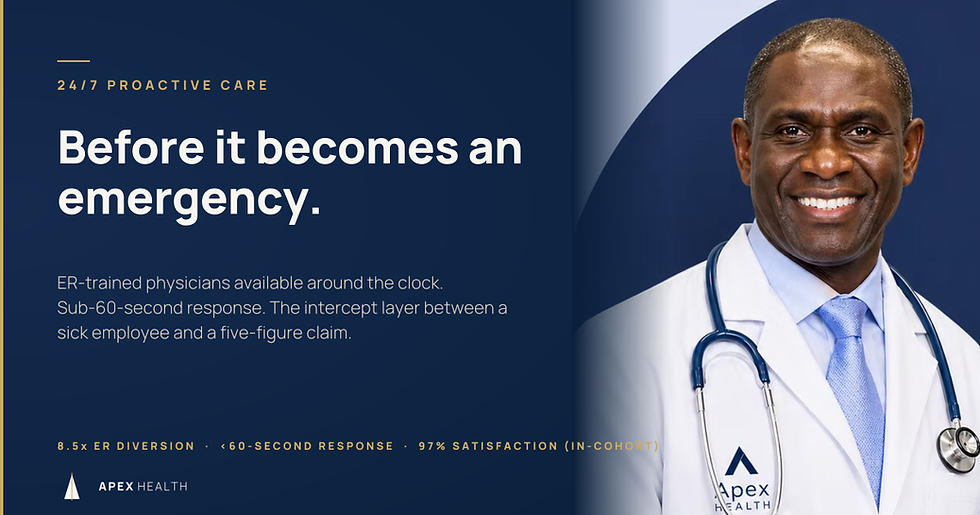
Apex Health helps employers reduce avoidable healthcare spend before it is priced into the next renewal cycle. We work alongside the existing carrier and plan structure to improve claims performance in real time through physician-led access, navigation, triage, Rx oversight, and proactive clinical intervention. The objective is straightforward: lower preventable claims, improve employee access, and restore leverage before the next renewal discussion starts.
That matters because once a bad claims year is fully developed, the options narrow. You are negotiating from weakness. Once claims performance improves earlier in the cycle, the conversation changes. Finance sees a cleaner trend line. HR sees fewer friction points. Leadership has a stronger position. The broker has better ground to work from. The renewal outcome becomes more manageable because the underlying risk has started to change.
The employers that will get hurt most in this environment are not necessarily the ones with the sickest populations. They are the ones that remain passive.
The market has already issued the warning. Mercer says 2026 is shaping up as the highest health benefit cost increase in 15 years. Business Group on Health says employers are bracing for a median 9% increase. PwC says group medical cost trend remains elevated at 8.5%. KFF shows that family coverage is already nearing $27,000, with employees carrying a meaningful share of that burden. The signal is clear: healthcare is not becoming easier to absorb, and waiting is not a strategy.
Call to action
If your organization is heading toward another renewal with rising claims pressure, Apex Health can identify where avoidable spend, utilization leakage, and prescription-driven cost are putting the plan at risk before those costs compound. Visit the Apex Health website and request a Claim Risk Assessment to see where the next savings opportunity is hiding.



Comments