
Renewal Season Is a Trap
- Apr 3
- 3 min read
Updated: Apr 6
Benefits managers and HR leaders don’t get rewarded for trying hard. You get rewarded for outcomes: claims down, churn down, employee trust up, leadership off your back.
Yet most benefits strategies still revolve around the same annual ritual:
review last year’s claims (late),
negotiate premiums (reactive),
tweak contributions (political),
roll out another wellness memo (ignored),
then hope next year is different.
It won’t be.
Because renewals don’t control costs. Behavior does.
And behavior changes before the renewal conversation—quietly, daily, one decision at a time.
If you’re serious about protecting your people and your P&L, this is the standard to adopt.
The 5 things that matter most to Benefits + HR (but rarely get addressed directly)
1) Predictability
Leadership doesn’t fear high costs as much as they fear surprises.
If your plan produces random, unforecastable spikes, you lose confidence—fast. The real job is turning healthcare from a “mystery expense” into something you can anticipate, influence, and govern.
Question to ask: What are the top 10 drivers of spend, and which 3 can we reduce in 90 days?
2) Claims Behavior (Not “Plan Design”)
A plan is just the rules of the road. Spend is driven by how people use the system:
ER vs urgent care vs telehealth
primary care avoidance
unmanaged chronic escalation
specialty/Rx leakage
delayed care that becomes catastrophic care
You can negotiate your rates all day—if utilization stays the same, your costs will rebound.
Translation: If you don’t change utilization, your renewal is theatre.
3) Employee Trust (and Adoption)
Most benefits rollouts fail because employees don’t believe anyone is actually there for them when it matters.
They don’t want another portal. They want:
immediate access,
a real clinician,
someone who can navigate the system for them,
and fewer surprises.
If your employees don’t adopt the “front door,” they default to the most expensive doors.
4) Proof (Not Promises)
Benefits managers are allergic to vendor hype for a reason: you’ve been burned.
What matters:
measurable reduction in avoidable claims
utilization shifts you can see
Rx and specialty controls with hard numbers
a timeline that produces results before renewal leverage is lost
If a vendor can’t show you how savings happens operationally, it’s not a strategy. It’s a story.
5) Career Safety
Let’s say the truth out loud: you’re not just managing benefits—you’re managing risk to your role.
A bad year can cost you credibility. A second bad year can cost you your seat. HR and Benefits leaders need systems that reduce downside variance.
This isn’t just healthcare. It’s governance.
The uncomfortable truth: most employers are managing outcomes at the wrong point in the timeline
Most teams act when the bill shows up.
But healthcare is a cause-and-effect system:
You don’t “renew” your way into savings.
You operate your way into savings.
So here’s the real question: What are you doing this month that will change next quarter’s claim experience?
A better operating standard for Benefits + HR
Adopt this simple scorecard and force clarity:
Access: Do employees have a clinician-led front door they actually use?
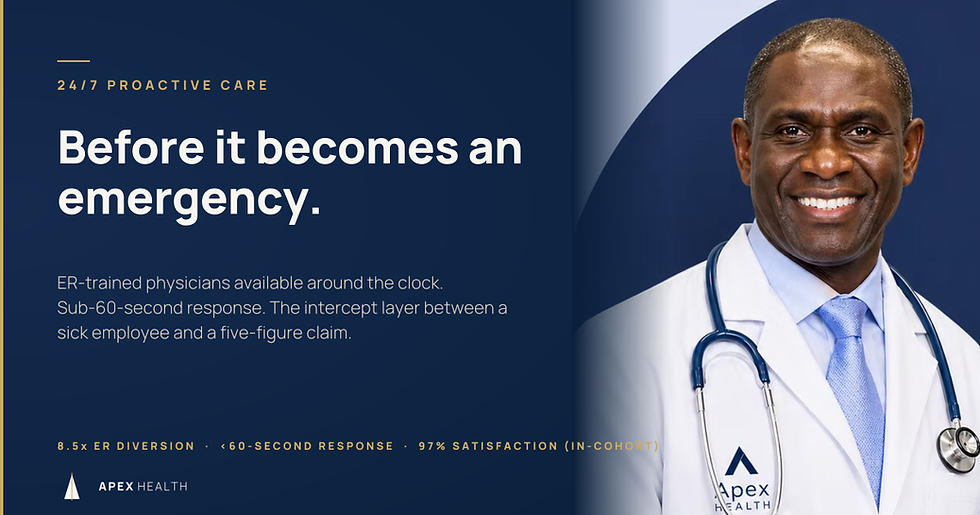
Diversion: Are you actively reducing avoidable ER/urgent care claims?
Rx discipline: Are specialty and high-cost scripts managed, or leaking?
Early flags: Are rising-risk members identified before they become 6-figure claimants?
Reporting cadence: Do you get actionable insights fast enough to intervene?
If you can’t answer these cleanly, you don’t have a cost strategy—you have a renewal strategy



Comments