
The 2027 Plan Year Is Already Moving: Four Forces Reshaping Employer Healthcare — And the Operational Response
- May 15
- 4 min read
For self-funded and level-funded employers, the 2027 plan year renewal isn't a future problem. It's already in motion. The trajectory of your loss ratio, your stop-loss exposure, and your renewal terms is being set right now — 4 to 6 months upstream of the renewal date itself. Once the data is locked, your options narrow to three: cut benefits, raise employee contributions, or absorb the hit.
Mercer's 2024 National Survey of Employer-Sponsored Health Plans projected health benefit costs to rise at the fastest rate in over a decade. Rate notifications coming through Q3 and Q4 of 2026 are validating that trajectory. HR and finance teams across the country are having the same conversation right now: the renewal math doesn't work, and the standard levers don't have enough left in them.
The good news is that the underlying forces driving 2027 costs are knowable. The harder news is that the response can't be a benefits-only conversation anymore. It has to be operational.
Here are the four forces shaping the 2027 employer healthcare cost landscape — and the response that's working.
Force 1: Renewal pressure is structurally locked in

Healthcare cost trend is no longer cyclical. Inflation in healthcare services, rising specialty drug costs, deferred utilization carryover, and aging employer populations have combined into sustained upward pressure that carriers are no longer absorbing. The result is rate increases that compound year over year — not 12-month resets that flatten back out.
The structural issue: by the time a CFO sees the renewal proposal, the loss ratio driving it is already locked. Sixty to ninety days before renewal is too late to change the math. The window where intervention actually shifts the data is 4 to 6 months upstream — when utilization patterns and claim trajectories are still actionable.
The buyers who solve their 2027 problem are the ones moving now, not in October.
Force 2: Pharmacy budgets are breaking on GLP-1
GLP-1 medications — Ozempic, Wegovy, Mounjaro, Zepbound — have reshaped the pharmacy line item faster than any drug category in modern memory. KFF and Mercer 2024 data show GLP-1 prescriptions driving the largest single increase in employer pharmacy spend in years, and the demand curve isn't flattening.
For self-funded employers, the response options have been polarized: either deny coverage and absorb employee dissatisfaction, or cover broadly and absorb the cost. Both responses cede the operational question — which is whether the prescriptions are clinically supervised, monitored for outcomes, and managed against the underlying conditions they're prescribed to address.
The middle path is physician-led oversight: clinical management that protects outcomes while disciplining utilization. Not gatekeeping. Not denial. Active management. Apex Health delivers this as part of the integrated care management layer — and typical Rx optimization in client cohorts runs 20–40%.
Force 3: Avoidable ER visits are still eating the plan
This pain point isn't new — it's been a known cost driver for two decades. What's changed is that the standard responses (basic telehealth tools, nurse lines, EAP-style triage) haven't actually moved the needle on default ER behavior. Employees still go to the ER for conditions that should never have generated an ER claim.
The reason is operational, not behavioral. When the alternative to the ER is a 14-day wait for a primary care appointment, a fragmented telehealth tool that doesn't continue care, or a nurse line that just redirects them anyway, employees correctly conclude that the ER is the only path that actually delivers care that day. The default isn't irrational. It's a response to a broken alternative.
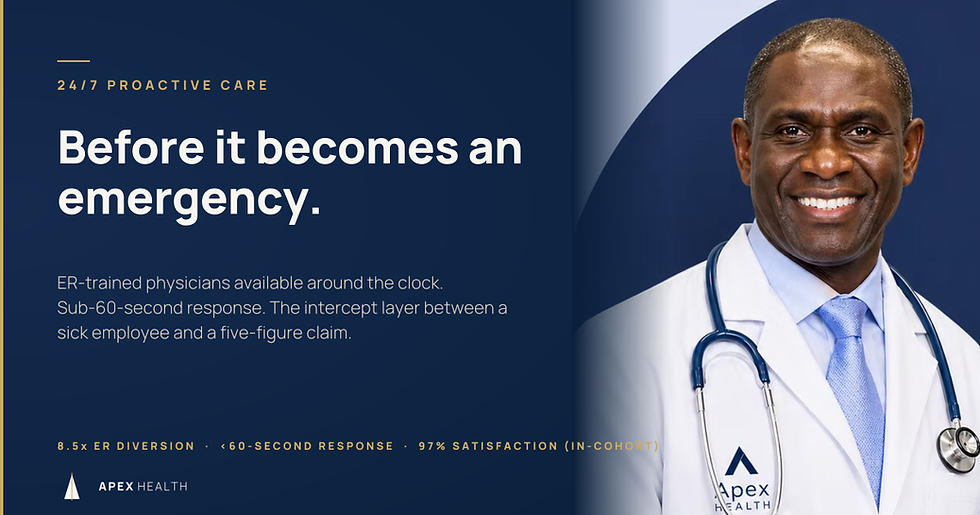
The operational response is real clinical access at the right level, at the right time. Apex Health pairs 24/7 ER-trained virtual primary and urgent care with integrated care management — so the alternative to the ER is a physician who can actually deliver care, not a triage tool that adds friction. In typical client cohorts, this produces 8.5x ER diversion and 45% readmission reduction.
Skip the ER for non-emergencies — call 911 for true emergencies.
Force 4: The 5% problem is the catastrophic claim problem
AHRQ Medical Expenditure Panel Survey data has documented the same pattern for years: roughly 5% of any insured population drives roughly 50% of total healthcare spending. For self-funded employers, that 5% is the catastrophic claim risk that haunts every CFO — the case that breaks stop-loss attachment, blows up the loss ratio, and sets the next renewal.
The hard part has never been the statistic. It's been knowing which 5% — before the high-cost event happens. Reactive care management identifies these employees after the claim hits. Predictive risk stratification identifies them before.
This is the Predict layer of Apex Health's Predict-Care-Integrate framework. AI risk stratification layered across the employee population identifies rising-risk individuals through claims data, utilization patterns, and predictive analytics — and feeds them into proactive care management before the cost event materializes. The economics shift dramatically when intervention happens early, not late.
The operational response
None of these four forces will resolve on their own. Carriers will not absorb them. Brokers will not solve them — they're not built to. And the standard benefits stack of plan design, contribution adjustments, and reactive case management has run out of leverage.
What's working is a clinical care management layer that sits above the existing carrier and broker stack — not as a replacement, but as the operational discipline the stack has been missing. That's Apex Health.
Apex Health is the physician-led platform for employer healthcare cost reduction. We work alongside your existing carrier and broker, layering predictive analytics, 24/7 ER-trained virtual primary and urgent care, integrated care management, remote patient monitoring, physician-led GLP-1 oversight, and one-to-one behavioral health support across your population.
Typical claims reduction in client cohorts: 30–50%. PMPM fees are deductible as ordinary and necessary business expenses under IRS §162; structuring options under §105 HRA should be discussed with your tax counsel.
The 2027 question
If 2027 is coming for you — and it is — the question is whether your renewal is going to be set by trends you didn't control, or by an operational layer you put in place upstream of it.
The window is 4 to 6 months ahead of renewal. For most January 1 plans, that means the conversation needs to happen now.
Skip the ER for non-emergencies — call 911 for true emergencies.


Comments