
The Future of Employer Healthcare Is Tiered
- May 9
- 3 min read
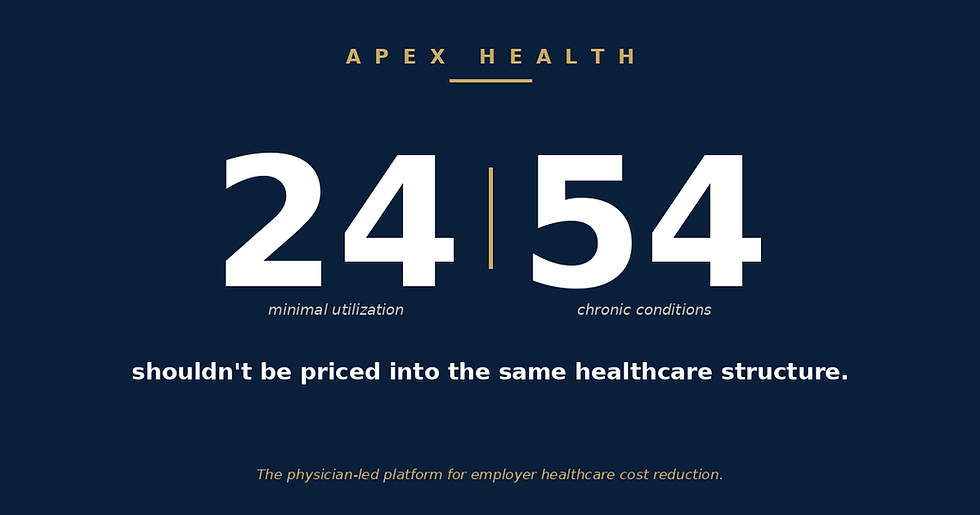
A 24-year-old and a 54-year-old shouldn't be priced into the same healthcare structure. Most are. Here's what changes when employers stop treating it that way.
A 24-year-old healthcare user thinks about coverage completely differently than a 54-year-old managing chronic conditions, specialty medications, and family health exposure.
Different risks. Different needs. Different financial calculations.
Yet most employer plans price both populations into the same escalating structure. It's the inherited model — administratively simple, easy to renew, and increasingly expensive for everyone in it.
The cost is real:
Younger employees decline coverage entirely
Participation pools destabilize
Catastrophic claims emerge years later that could have been intercepted at the preventive stage
Carriers raise rates because the people who stay are the ones who use it most
Renewals climb 8 to 15 percent annually as "what the market is doing"
This isn't a sophistication problem. It's a structural one. The model wasn't designed for today's workforce demographics.
The Younger-Employee Opportunity Most Employers Miss
The biggest financial leverage point in employer healthcare right now isn't on the high-utilization end of the population. It's on the low-utilization end — the employees most plans currently lose.
When a 24-year-old declines employer coverage, three things happen the company never measures.
The employee disappears from the healthcare system entirely. No primary care. No preventive screening. No early intervention.
The company's risk pool concentrates around higher-utilization users — which is exactly the wrong direction for renewal economics.
And that disengaged 24-year-old becomes a 38-year-old with undetected hypertension. Or a 42-year-old with late-stage diabetes. Or a 50-year-old presenting with a cardiac event that could have been a $400 conversation fifteen years earlier.
The 30 to 50 percent claims reduction that's possible in tiered structures isn't only about better managing the high-cost claimants. It's about not creating future high-cost claimants by leaving younger employees outside the system entirely.
What Apex Health's Guided-Access Framework Actually Is
For younger employees, the goal isn't unlimited healthcare access. It's three things:
Avoiding financial destruction from unexpected events
Maintaining preventive guidance before something escalates
Staying connected to a physician-led care system
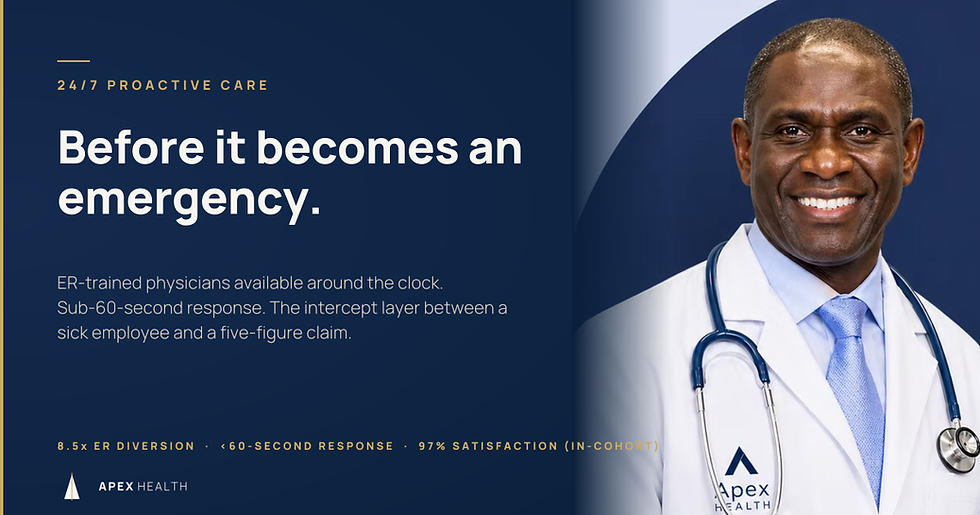
The structure that delivers this looks different from a traditional plan. Lower per-member-per-month costs. 24/7 access to ER-trained physicians. Preventive triage. Catastrophic-risk protection. Care navigation when something does come up.
This is what we built Apex Health to deliver. Physician-led 24/7 access for the routine and the rising-risk. AI risk stratification that flags conditions before they escalate. Integrated care management for the complex cases. An economic structure designed so finance teams can model healthcare like every other operating expense — including PMPM treatment that's deductible under IRC §162 and improves further when integrated with a properly structured Section 105 HRA.
The result: employees who would have opted out of a traditional plan opt into a guided-access framework — because the cost-to-coverage ratio actually makes sense for their situation.
What This Does to the Whole Pool
When younger employees re-engage with the healthcare system, three things shift across the entire population.
The participation pool stabilizes. Carriers underwrite differently when the risk profile flattens.
The predictive layer catches things earlier across every age cohort.
Renewal economics change. Predictable PMPM trajectories replace volatile premium increases.
For older employees and those managing chronic conditions, the established care management infrastructure works the same way it always has — coordinated clinical care, RPM, GLP-1 oversight, integrated case management. None of that changes.
What changes is that the younger end of the population stops dragging the entire renewal economics in the wrong direction.
The Competitive Timing
The employers building tiered healthcare structures now will have a meaningful financial advantage over the next decade. Stable participation. Predictable renewals. Engaged workforces. Lower catastrophic exposure.
The employers absorbing 10 to 15 percent annual renewal increases without restructuring will be paying significantly more for significantly worse outcomes.
The shift is happening at the leading edge of the market. The question is which employers move first.
If This Resonates
If you're a CFO, COO, or HR leader running a self-funded plan and you've never modeled what a tiered structure could do to your participation rates and claims trajectory — the math is worth running.
Reach out. Happy to walk through what this looks like for an organization your size.


Comments